
Concentrated Stock Position: Your Company Made You Wealthy. What Happens Next?
A concentrated stock position can create significant wealth and significant risk. Learn how to think about liquidity events, financial independence, and wealth preservation.
Rakesh Shah
6/19/20263 min read
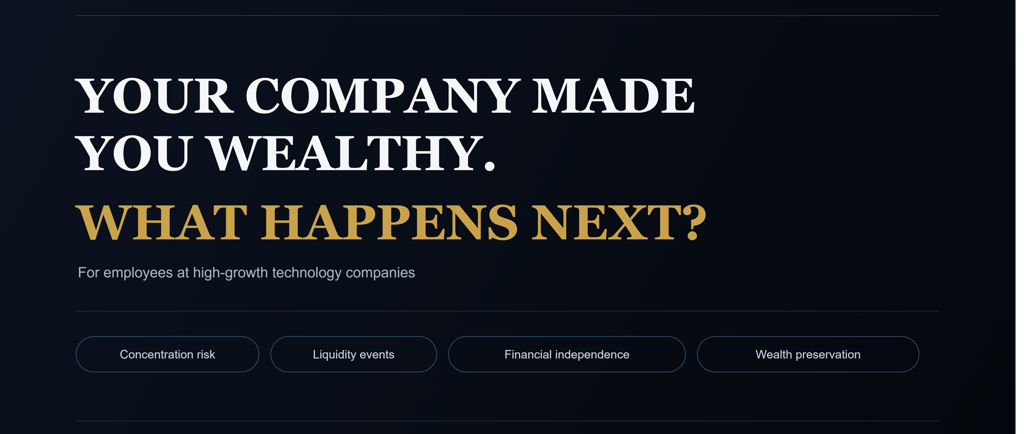

A Note to Employees at NVIDIA, SpaceX, OpenAI, Anthropic, Stripe, Databricks, Tesla, and Other High-Growth Technology Companies
A few years ago, my brother asked me a question.
At first, it sounded simple.
But the more I thought about it, the more I realized it was one of the most important financial questions I had ever heard.
He asked:
"What do people do after they become wealthy?"
Not how they become wealthy.
What happens after.
At the time, he had reached a point where years of hard work, disciplined saving, and investment success had created opportunities—and decisions—that he had never faced before.
As we worked through those questions together, I started reaching out to people in my network: executives, business owners, investors, professionals, and others who had experienced significant wealth-creation events.
I expected very different answers.
What surprised me was how similar the questions were.
The details changed.
The underlying concerns did not.
And that's when I noticed something.
There are thousands of articles explaining how to build wealth.
Very few discuss what happens after you've built it.
The Day Success Creates New Problems
Imagine two employees.
Same company.
Same start date.
Same stock grants.
Same talent.
Same dedication.
Ten years later, both are sitting on company stock worth roughly $10 million.
From the outside, they look identical.
Internally, they're facing very different challenges.
The first challenge was becoming wealthy.
The second challenge is deciding what to do with that wealth.
Most people spend decades preparing for the first challenge.
Very few spend time preparing for the second.
Nobody Talks About This Part
When your company stock begins to represent a meaningful portion of your net worth, the questions start changing.
Not investment questions.
Decision questions.
Questions like:
If my stock doubles again, would I regret selling?
If my stock falls 50%, would I regret not selling?
At what point does conviction become concentration risk?
If 70–80% of my net worth is tied to one company, am I diversified or dependent?
Am I financially independent—or simply stock-price dependent?
If a liquidity event happened tomorrow, how much would my family actually keep after taxes and future obligations?
Have I spent years optimizing wealth creation while giving almost no attention to wealth preservation?
If I achieved financial independence tomorrow, would I even recognize it?
How much wealth is enough for the life I'm actually trying to build?
If I suddenly had liquidity, would I have a plan—or simply a large cash balance?
What struck me over the years wasn't that people had different answers.
It was that many highly successful people had never been asked these questions at all.
The Million Dollar Question Nobody Asks
Let's assume your company stock becomes worth $10 million tomorrow.
Here's the question:
How much of that $10 million do you actually consider yours?
Not on paper.
Not in a brokerage statement.
Not in a net-worth calculation.
Yours.
After taxes.
After future taxes.
After risk.
After inflation.
After market cycles.
After mistakes.
After life happens.
Because there is a difference between being worth $10 million and having a strategy for $10 million.
One is a number.
The other is a plan.
The Hidden Risk Isn't Always The IRS
Many people assume taxes are the biggest threat.
Taxes matter.
But over the years, I've noticed that the biggest financial mistakes rarely come from poor investments.
More often, they come from unanswered questions.
Questions that sit quietly in the background while wealth is being built.
Questions that seem unimportant because the stock keeps rising.
Questions that suddenly become urgent when an IPO, tender offer, major stock sale, retirement decision, or unexpected life event arrives.
By then, the clock is already running.
Two Employees. Two Futures.
One employee treats a liquidity event as a finish line.
The other treats it as a transition point.
The first focuses on the stock.
The second focuses on the decisions surrounding the stock.
Five or ten years later, the difference between them may have very little to do with investment performance.
It may have everything to do with the quality of the decisions they made when new choices became available.
Not because one was smarter.
Because one started asking better questions sooner.
Why I Wrote This
I didn't write this article because I'm fascinated by taxes.
Or stock options.
Or IPOs.
I wrote it because my brother's question stayed with me.
"What do people do after they become wealthy?"
The more conversations I had, the more I realized that wealth creation is only one chapter.
Success creates a new set of decisions.
And surprisingly few people spend time preparing for them until they're standing directly in front of them.
Final Thought
Over the years, I've noticed that the biggest financial mistakes rarely come from poor investments.
They come from unanswered questions.
Questions that are easy to postpone while wealth is being built.
Questions that become difficult to ignore once meaningful wealth arrives.
If this article caused you to think about a question you haven't fully answered yet, then it has served its purpose.
Because becoming wealthy is a milestone.
Learning how to navigate what comes next is a completely different challenge.
And for many people, it's the one nobody prepared them for.
About Author
Rakesh Shah is Founder of Sure Life Plans and MITL Quant Alpha. He writes about wealth, decision-making, risk, and the questions people face after significant wealth-creation events.